Remembering Juniper Blessing

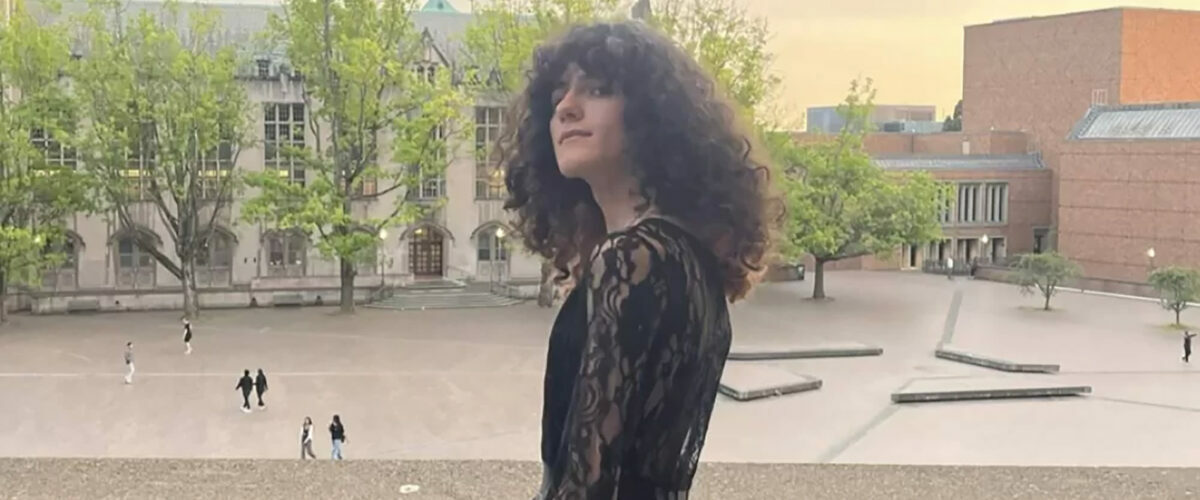
Remembering Juniper Blessing
On May 10, a 19-year-old student at the University of Washington died in the laundry room of an off-campus apartment complex, Nordheim Court.
This student did not die from natural causes, from drug use or cancer. Juniper Blessing died after being stabbed more than 40 times.
Juniper was transgender.
When someone is brutally murdered, many questions arise. In Juniper’s case, many of those questions remain unanswered. Regardless of the cause of the crime, it is important to stop and take note of the precious life of someone like Juniper.
Juniper was born and raised in Princeton, N.J. They attended Littlebrook School and Princeton Middle School before moving to Santa Fe, N.M., in 2018. Juniper, a gifted singer with an extraordinary voice, was admitted to the New Mexico School for the Arts, where they studied and graduated in 2024.
Recently, Juniper moved to Seattle to attend the University of Washington. They were studying atmospheric science, while also minoring in philosophy and music. Juniper’s family described them as “highly intelligent, extremely talented and deeply sensitive to the needs of others.” Friends spoke of Juniper as kind, dedicated to whatever they were involved in, and a loyal friend.
Tragically, all future aspirations came to a premature end when Juniper was brutally murdered on Mother’s Day.
A few days after the murder, local police investigators released vivid images of a suspect who was caught on surveillance footage in the building at the time of the murder. Later that day, Belleview resident Christopher Michael Leahy turned himself in to the police and was arrested for the murder of Juniper Blessing. He is being held in King County Jail on a $10 million bail; prosecutors are seeking a 20-year prison sentence.
The cause of the crime remains uncertain. Whether Leahy knew the victim seems improbable. Perhaps this vicious murder was coincidental and random. Perhaps this is another example of a hate crime. The verdict will be for the judge and jury to determine based on the evidence provided in court.
In a statement from the family of Juniper Blessing after the charges were officially filed against Leahy, they expressed appreciation to the police, prosecutor’s office and medical examiner. The family concluded with these touching and heartfelt words:
Today and every day, we remain focused on our Juniper, whose loving spirit has no bounds. Juniper was a beautiful human being with a heart full of love, tolerance, talent, determination and intellectual curiosity that was a light in our world and to the world at large.
We also wish to thank the Seattle community, whose response to this tragedy has been overwhelming, the community of Santa Fe, and LGBTQIA2S+ communities and advocates across the country who are memorializing and keeping vigil for Juniper by saying her name with love, honor and respect. Thank you for standing beside our family as we grieve the loss of our beloved Juniper. Every gesture of support is another candle lit and another flower which blooms in Juniper’s memory.
Juniper Blessing was dearly loved by family and friends, as evidenced by the memorial in Red Square at the University of Washington, which is filled with flowers, candles and hand-written notes. As a passionate Pokémon fan, they chose the name Juniper after the first female professor in the Pokémon Main Series games. They also collected and treasured old Nintendo DS games. In addition to musical abilities, Juniper was known for kindness, a happy disposition and eagerness to help others.
Based on a study by the UCLA Williams Institute, transgender people are more than four times more likely than cisgender people to be victims of violent crime. Additionally, the Trevor Project just released its 2025 survey results. Their research indicates that, in the past year, 40% of transgender and nonbinary young people seriously considered suicide; and when they were unable to access the hormones they needed, they were nearly twice as likely to attempt suicide.
Yet, Juniper Blessing moved to Seattle believing it would be a safe environment. Tragically, it was not as safe as they hoped. According to the Movement Advancement Project, Washington is one of 23 states that explicitly list gender identity and sexual orientation in laws against hate crimes. Even in more progressive environments, such as Seattle, people are targeted because they are LGBTQ.
Lawmakers and medical insurance companies continue to make it exceptionally difficult for transgender and nonbinary young people to access hormones to support their gender transition or expression. According to the current ACLU tracker, there currently are 788 bills introduced across the country that seek to block transgender people from receiving basic health care, education, legal recognition and the right to publicly exist.
Unfortunately, much of this anti-trans rhetoric is coming from religious spaces and far-right conservative leaders. For example, at the recent Rededicate 250 rally in Washington, D.C., on May 17, evangelical preacher Franklin Graham warned of the dangers of becoming a “morally rotten, completely sick with sin” country. He went on to clarify what he meant: “Transgenderism, same-sex marriage, opening women’s lockers rooms to men are just the tip of the iceberg.”
Graham, like other Christian nationalists, paints a false depiction of American history. Glamorizing the founding of our country as a “Christian nation,” they assume American values have deteriorated and we need to get back to the foundation they believe America was built on: conservative values (as they define them), theocratic government, prioritized teaching of the Bible in the public schools, and censorship of anything that does not align with their stated position.
While such faith leaders may be quick to skirt responsibility for crimes of heinous murder, they fail to recognize the blood on their hands. Whether or not they hold the knife (or gun), they are cultivating an ethos in our country that directly links to the actions of hate and violence against others, especially marginalized communities.
People like Graham are quick to point the blame elsewhere (for example, video games) but fail to see the log in their own eye as they strain at the speck in the eye of another.
While I disagree with much of Franklin Graham’s speech at Rededicate 250, I wholeheartedly agree with this he said: “As we prepare to observe this important milestone in our nation’s history, there is no better moment than right now for each of us to look deep into our own hearts and quietly repent of our sins and call upon the name of Almighty God.”
Franklin, I will meet you on my knees, praying in confession and repentance. It will be there that I also will pray for comfort and peace for the family of Juniper Blessing. It will be there that I also will pray we might be a people who exhibit the acceptance, connection and joy — yes, even pride — in our LGBTQ brothers and sisters. It will be there where I will pray for a kingdom of God where all are welcome, cherished and loved not only by God but by all of those who call themselves Christians. It will be there that I will pray that articles like this will one day be unnecessary.
It will be there that I will remember and speak this name: Juniper Blessing.
Patrick Wilson has served as a pastor 25 years in Dallas and Austin, Texas, and most recently in in Rolla, Mo., where he now leads a community of faith, CrossRoads. He is a graduate of Baylor University, earned two master’s degrees at Southwestern Baptist Theological Seminary and a Doctor of Ministry degree from Logsdon Seminary.