In a world of bridge burners, we need more bridge builders

In a world of bridge burners, we need more bridge builders
On July 27, the Gordie Howe International Bridge opened to the public, traversing the Detroit River from Detroit to Windsor in Ontario, Canada. Efforts to build the bridge began back in 2012 with the formation of the Windsor-Detroit Authority.
The bridge’s six lanes connect US Interstate 75 with Canadian Highway 401. In addition to automotive traffic, pedestrians and cyclists can cross the bridge between the United States and Canada toll-free.
The passageway across the Detroit River has been a significant trade route since the Civil War, when people ferried from one side to the other. In 1910, the Michigan Central Railway opened an underground railroad tunnel below the river to further expand international commerce. This railway system is still in use today and plans are in development for Amtrak to use it for passenger service.
Until now, the main thoroughfare from Detroit to Windsor has been the Ambassador Bridge, which opened in 1929. This bridge is the busiest truck crossing of the border between the U.S. and Canada, with about 25% of traffic. Bridges like the Ambassador Bridge and now the Gordie Howe International Bridge provide access to about 5,000 Canadians who commute to work in Detroit and the extensive trade between the two countries. For context, the automotive trade between the U.S. and Canada is worth about $51 billion per year.
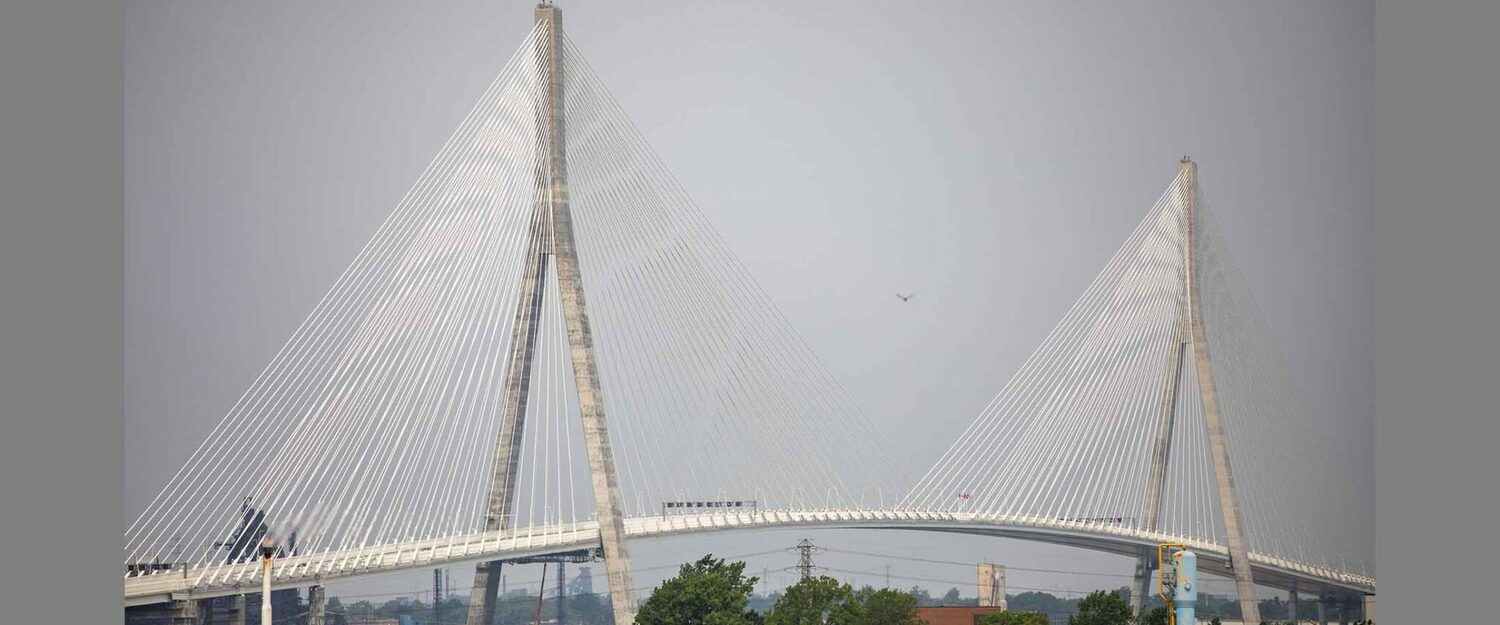
Construction of the Gordie Howe International Bridge began on July 17, 2018, and took nearly eight years to complete. The bridge is supported by two 722-foot-tall A-shaped towers, one on each bank of the river. The towers are said to resemble hockey sticks swung in a slapshot as further tribute to the namesake of the bridge, a Hall of Fame Canadian ice hockey player who played for the Detroit Red Wings for 25 years.
The bridge is supported by 216 cable stays and has the longest main span of any cable-stayed bridge in North America (2,800 feet). The total dimensions of the bridge are 1.6 miles across by 151 feet high.
The use of these massive cables provides stability for the Gordie Howe International Bridge without underwater piers in the river. Not having underwater pillars makes a more open and safe water passage for large boats on the Detroit River, yields greater water flow and prevents winter ice jams from crashing into support pillars, aiding the environmental protection of the river.
The Gordie Howe International Bridge is jointly owned by the Canadian government and Michigan. Once construction costs are recuperated (which were fronted by Canada), toll fees will be split between the state of Michigan and Canada. Yet, for the last 18 months, the Trump administration has been hostile toward Canada, continuing to threaten extreme tariffs against our northern neighbors.
These aggressions disrupted the opening of the bridge. In February, President Donald Trump made additional demands of Canada, one of which was that the U.S. receive at least half ownership of the Gordie Howe International Bridge. The ribbon cutting was scheduled back on June 12, but it was postponed due to the ongoing disputes between the countries. On July 10, Canada announced that a negotiation was reached with the U.S. administration and that the bridge would open on July 27.
Some believe the delays were related to meetings held between the presidential administration and Matthew Moroun, owner of the aforementioned Ambassador Bridge, who made a $1-million donation to the Trump political action committee in January. Soon after a meeting between Moroun and U.S. officials in February, Trump commented on Truth Social that he would not allow the bridge to open.
Nonetheless, on July 27, Michigan Gov. Gretchen Whitmer marked the official opening of the bridge by driving a black Ford Mustang convertible from Detroit to Windsor. In a press release, Whitmer stated, “Built by skilled workers on both sides of the Detroit River, this bridge is an engineering marvel — but more importantly, it’s a symbol of the partnership that has defined our two communities for generations. … This bridge brings people together. It will strengthen our economy, create new opportunities and stand as a lasting reminder that we can accomplish big things together.”
Scripture encourages us to build others up rather than tear them down, to welcome the stranger and to encourage collaboration. America is stronger when we work together with our neighbors, come alongside each other and seek common good.
For example, in our little community of Rolla, Mo., a group formed in 2025 with a mission to help immigrants experiencing detainment by U.S. Immigration and Custom Enforcement. After a man detained by ICE in the local Phelps County Jail died by suicide, Abide in Love organized to make a difference, one person and one family at a time.
Over the last year, Abide in Love has expanded into seven chapters in three states, providing contacts as pen pals, small donations for phone calls and necessities to detainees, and support to families. The organization centers on the core principles of nonviolence of Martin Luther King Jr., striving to do what can be done to build bridges through relational connection, empathetic understanding and sacrificial love.
What can you do? How can your community rally together to help others?
Prioritize time to listen to people’s stories, understand and empathize with their lived experiences, and walk with them through their challenges. Through friendship, we can build bridges and truly abide in love.
Patrick Wilson has served as a pastor 25 years in Dallas and Austin, Texas, and most recently in in Rolla, Mo., where he now leads a community of faith, CrossRoads. He is a graduate of Baylor University, earned two master’s degrees at Southwestern Baptist Theological Seminary and a doctor of ministry degree from Logsdon Seminary.